











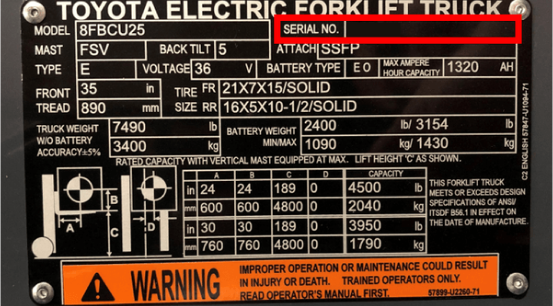
How to Find Your Equipment Model Number.
Finding the right parts for your equipment is easy when you have your model and serial number which can be found on the data plate. Luckily, a forklift data plate is installed on every truck on the market to help you understand what your forklift can do and provide vital information.
Model Number: The model number of your toyota forklift is extremely important for relaying information to your dealers about repair or technical assistance and for looking up replacements part!
Serial Number: The serial number on your lift is the most important number.The model serial number combination will allow us to provide you with the parts that will fit your particular piece of equipment.
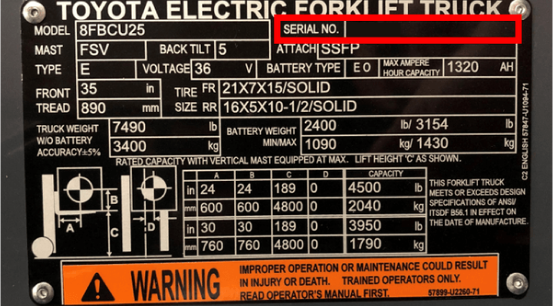
How to Find Your Equipment Serial Number.
Finding the right parts for your equipment is easy when you have your model and serial number which can be found on the data plate. Luckily, a forklift data plate is installed on every truck on the market to help you understand what your forklift can do and provide vital information.
Model Number: The model number of your toyota forklift is extremely important for relaying information to your dealers about repair or technical assistance and for looking up replacements part!
Serial Number: The serial number on your lift is the most important number.The model serial number combination will allow us to provide you with the parts that will fit your particular piece of equipment.
Need some help? For further assistance or more information, contact your local Toyota Dealer.












Please click below to sign in to your MyToyota account
Don't have an account?
Electric Forklifts FAQ

Common Electric Forklift Questions
How Long Does the Battery Last on a Single Charge?
Runtime depends on the battery type (lead-acid or lithium-ion), size, application intensity, and equipment usage. On average, a fully charged battery can support 6–8 hours of moderate operation. Lithium-ion batteries may offer longer, more consistent performance.
Can Electric Rider Forklift Handle Outdoor Environments?
While best suited for indoor or covered environments, some electric rider forklifts can operate outdoors on smooth surfaces in dry conditions. However, they are not designed for rough terrain or extreme weather.
What Are the Advantages of Electric Rider Forklifts Over Internal Combustion Models?
Electric forklifts offer quieter operation, lower maintenance costs, and energy efficiency. They're ideal for indoor environments such as warehouses, manufacturing facilities, and food storage facilities.
Are Electric Forklifts Available with Different Mast Heights and Lift Capacities?
Yes. Toyota offers electric rider models with various mast configurations and lift capacities to fit everything from low-clearance facilities to high racking systems.
Is There a Cost-Benefit to Switching From Propane or Diesel to Electric?
Yes. While electric forklifts may have a higher upfront cost, they typically offer lower lifetime operating costs due to reduced fuel expenses and maintenance.
What Kind of Maintenance is Required for Electric Motor Rider Forklifts?
Electric forklifts require less routine maintenance than internal combustion models. Key tasks include battery care, brake inspection, and electrical system checks. Lithium-ion options require even less upkeep.
Can I Retrofit My Existing Forklift with a Lithium-ion Battery?
In many cases, yes, but it depends on the model and battery specifications. Toyota offers lithium-ion compatible models and can help determine whether a retrofit is feasible for your equipment.
What Aisle Width Is Required for Electric Rider Forklifts?
Aisle width requirements vary based on the model, turning radius, and load size. Most electric rider forklifts are designed for standard warehouse aisles, but narrow aisle models may be required for tighter spaces.
How Does Regenerative Braking Work on Electric Forklifts?
Regenerative braking captures energy during deceleration and feeds it back into the battery, improving overall energy efficiency and helping extend battery life.
Can Electric Forklifts Handle Ramps or Inclines?
Yes, but within limitations. Most electric motor rider forklifts can handle inclines up to 10–15%, depending on load weight and battery power. Always consult model specifications for gradeability.
How Long Does it Take to Fully Charge an Electric Forklift Battery?
Charge times vary by battery type. Lead-acid batteries typically take 8 hours, while lithium-ion batteries can charge in as little as 1–2 hours with the right charger.
Is An Electric Forklift a Good Choice for Multi-Shift Operations?
Yes, especially when using lithium-ion batteries, which offer faster charging, opportunity charging, and no need for battery swaps between shifts.
What Should I Consider When Switching From Internal Combustion to Electric Forklifts?
Consider infrastructure (charging stations), battery type, load requirements, and your application’s duty cycle. You may also benefit from consulting with your dealer for a full cost-benefit analysis.
How Do I Properly Care for My Forklift Battery?
Regular inspections, cleaning terminals, and monitoring water levels (for lead-acid) help maintain performance. Lithium-ion batteries require less maintenance but should still be checked periodically.
Are Special Chargers Required for Lithium-ion Batteries?
Yes. Lithium-ion batteries require chargers that are specifically rated for their chemistry and voltage. Always use manufacturer-approved charging equipment for safety and compatibility.
What Are Some Signs That My Electric Forklift Battery Needs Replacement?
Reduced runtime, frequent charging, voltage drops under load, or slower lifting performance are common signs that it’s time to replace or service your battery.