







How to Find Your Equipment Model Number.
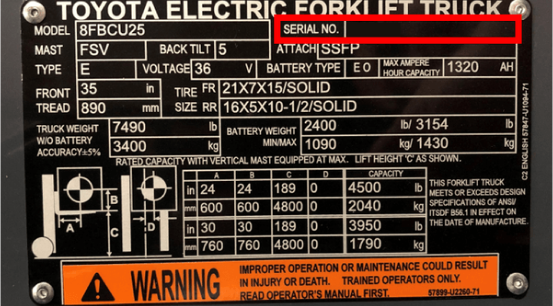
Finding the right parts for your equipment is easy when you have your model and serial number which can be found on the data plate. Luckily, a forklift data plate is installed on every truck on the market to help you understand what your forklift can do and provide vital information.
Model Number: The model number of your toyota forklift is extremely important for relaying information to your dealers about repair or technical assistance and for looking up replacements part!
Serial Number: The serial number on your lift is the most important number.The model serial number combination will allow us to provide you with the parts that will fit your particular piece of equipment.
How to Find Your Equipment Serial Number.
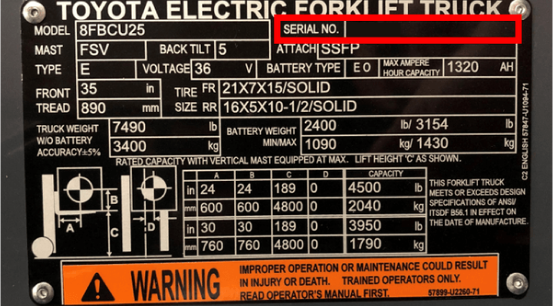
Finding the right parts for your equipment is easy when you have your model and serial number which can be found on the data plate. Luckily, a forklift data plate is installed on every truck on the market to help you understand what your forklift can do and provide vital information.
Model Number: The model number of your toyota forklift is extremely important for relaying information to your dealers about repair or technical assistance and for looking up replacements part!
Serial Number: The serial number on your lift is the most important number.The model serial number combination will allow us to provide you with the parts that will fit your particular piece of equipment.
Need some help? For further assistance or more information, contact your local Toyota Dealer.










Please click below to sign in to your MyToyota account
Don't have an account?
Buying Guide: Stand-Up Rider vs. Sit-Down Electric Forklifts

Choosing between a Stand-Up Rider and a sit-down electric forklift can directly impact your operation’s productivity, efficiency, and safety. While both are designed for similar applications, each excels in different environments. Understanding these differences is key to selecting the right solution for your workflow.
Stand-Up Rider vs. Sit-Down Forklifts: Which Should You Choose?
A Stand-Up Rider Forklift is best for operations with frequent stops, tight aisles, and high pick rates. A sit-down electric forklift is better suited for longer travel distances, higher speeds, and heavier lifting capacities.
The right choice depends on your facility layout, operator workflow, and overall productivity goals.
Factors to Consider When Choosing the Right Forklift
On/Off Frequency
One of the main reasons you would consider using a Stand-Up Rider is the fact that getting on and off the forklift can be considerably faster. With lower step heights and no seatbelt to put on and take off, time spent entering and exiting can be significantly reduced. Over time, these small time savings can add up to meaningful gains in productivity and labor efficiency. Sit-down forklifts, on the other hand, are better suited for applications where the operator remains seated for extended periods of time.
Performance & Productivity
Sit-down electric forklifts typically offer higher travel speeds and faster lift/lower functions, making them a great choice for high-throughput applications. However, both sit-down models and the Stand-Up Rider come equipped with optional lithium-ion batteries that offer consistent power and battery voltage helping increase performance and efficiency throughout an entire shift.
Lifting Capacity
Stand-Up Rider and sit-down forklifts are both counterbalance forklifts, but their design influences their performance at height.
- Stand-Up Rider offers lifting capacities ranging from 3,000-5,000 lbs. and thrive when lifting at higher heights due to its compact footprint and three or four-stage mast options.
- Sit-Down Forklifts’ lifting capacities can vary anywhere from 3,000-17,500 lbs. and encompass the power to deliver maximum travel speeds and longer run times.
When comparing a Stand-Up Rider to a 3-Wheel Electric Forklift with the same base capacity, you typically get more lifting capacity from the Stand-Up Rider at higher lift heights due to the compact design and centralized center of gravity. Four-wheel electric models, such as the Core Electric Forklift, typically attain the highest lifting capacities overall.
Right Angle Stack
In general, right angle stacking capabilities are similar between the Stand-Up Rider and sit-down forklifts with similar capacities. When compared to a 3-Wheel Electric Forklift, Stand-Up Riders have a small advantage due to their shorter length and can operate in more narrow aisles. Both the Stand-Up Rider and 3-Wheel Electric forklifts have a significant advantage over the Core Electric Forklift on minimum aisle width requirements.
Operator Preference & Comfort
Operator preference often plays a major role in most purchasing decisions for new equipment.
- Stand-Up Riders utilize a multifunction control handle, adjustable operator controls and armrest, as well as comfort stance floor and knee pads to reduce operator fatigue and provide customizable controls for increased productivity and ergonomics.
- Sit-down forklifts feature similar ergonomic technology such as optional EZ Fingertip Controls®, full-suspension vinyl seats, and many other features.
Purchase Price & Acquisition Options
Weighing the initial cost is often one of the first factors considered when choosing between a Stand-Up Rider and sit-down forklift. While the sticker price is important, it’s only part of the equation. It’s important to evaluate the total cost of ownership, including productivity gains and operational efficiency, not just the initial investment.
While you can purchase the forklift outright, there are several other alternative acquisition options.
- Leasing: Ideal for operations looking to preserve capital and maintain predictable monthly costs. Leasing also makes it easier to upgrade equipment as technology evolves or operational needs change.
- Financing: Offers a middle ground between purchasing and leasing, allowing you to spread out payments while still owning the equipment over time.
- Renting: A flexible option for short-term needs, seasonal demand, or testing equipment before committing to a long-term investment. Renting can also help bridge gaps during peak periods or equipment downtime. For more information on renting, your local Toyota dealer can provide more information.
Making the Right Choice for Your Operation
There’s no one-size-fits-all answer when choosing between a Stand-Up Rider or a sit-down forklift. The right decision depends on your facility’s layout, workflow, and operational goals.
As you’re evaluating your options, working with an experienced partner can help you assess your needs and identify the best fit. Contact your authorized Toyota Dealer to find the right solution to keep your operation moving efficiently.
Frequently Asked Questions
Is a Stand-Up Rider Forklift better than a Sit-Down Forklift?
Neither is universally better. Stand-up forklifts are ideal for tight spaces and frequent stops, while sit-down forklifts are better for long-distance travel and higher lifting capacities.
Why choose a Stand-Up Rider Forklift?
Neither is universally better. Stand-up forklifts are ideal for tight spaces and frequent stops, while sit-down forklifts are better for long-distance travel and higher lifting capacities.
When Should You Choose a Sit-Down Forklift?
Sit-down forklifts are best for applications requiring longer travel distances, higher speeds, and heavier load handling.