













How to Find Your Equipment Model Number.
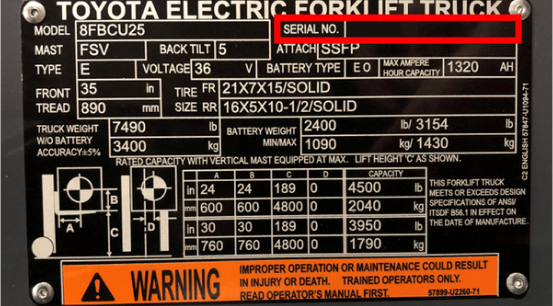
Finding the right parts for your equipment is easy when you have your model and serial number which can be found on the data plate. Luckily, a forklift data plate is installed on every truck on the market to help you understand what your forklift can do and provide vital information.
Model Number: The model number of your toyota forklift is extremely important for relaying information to your dealers about repair or technical assistance and for looking up replacements part!
Serial Number: The serial number on your lift is the most important number.The model serial number combination will allow us to provide you with the parts that will fit your particular piece of equipment.
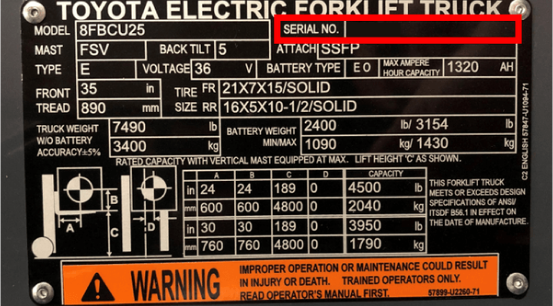
How to Find Your Equipment Serial Number.
Finding the right parts for your equipment is easy when you have your model and serial number which can be found on the data plate. Luckily, a forklift data plate is installed on every truck on the market to help you understand what your forklift can do and provide vital information.
Model Number: The model number of your toyota forklift is extremely important for relaying information to your dealers about repair or technical assistance and for looking up replacements part!
Serial Number: The serial number on your lift is the most important number.The model serial number combination will allow us to provide you with the parts that will fit your particular piece of equipment.
Need some help? For further assistance or more information, contact your local Toyota Dealer.










Please click below to sign in to your MyToyota account
Don't have an account?
3 Reasons Your Forklift May Be Overheating

Running a material handling business is a tall task – not only do you have to monitor your product, your sales, and your employees, you also have to ensure your forklift fleet is operating at its best capacity. Malfunctioning and overheating forklifts can skyrocket your operating costs and require expensive repairs. So what do you do if you’ve followed all maintenance suggestions and they are still overheating? Here are three areas that may be the cause of your forklift running hot:
Routine Maintenance Aids in Reduction of Overheating
The first area to check is also the easiest to fix: are routine maintenance tasks being completed correctly? Issues such as low coolant levels or worn hoses can contribute to a forklift’s overheating. If your on-site tech stretches parts past their optimal use, such as clogged filters, your forklifts could be choking on thick, dusty air. Worn fans or damaged radiators can also contribute to high running temperatures in material handling equipment.
Environment Affect on Forklift Temperature
The same advice for workers in high temperatures applies to your forklifts – give them frequent breaks and make sure their fluids are topped off.
Is your work yard paved or on packed dirt? Excessive dust, debris, and rough terrain can put additional demands on your forklifts and cause unforeseen maintenance problems. If this is a recurrent summer problem then the outside temperature can even be to blame. The same advice for workers in high temperatures applies to your forklifts – give them frequent breaks and make sure their fluids are topped off. If your forklifts are overheating indoors then you’ll want to survey your work area to find issues. Is the floor dusty or dirty? Are pieces of paper, pallet wrap, or other debris being left on the ground where they can clog filters? Once you find these issues then you can optimize your work areas to prevent damage.
Maintaining Proficient Operations Prevents Overheating Forklifts
If it’s not maintenance or environmental issues causing your overheating problems, then you need to check on how you are driving the equipment. If you are overloading the forklift with loads above capacity, this can cause overheating and create unnecessary risks for product damage and accidents. Are you driving forklifts constantly at top speeds? This can also contribute to high heats.
Many IC forklifts come equipped with an inching pedal to use when maneuvering your forklift while raising the mast to retrieve loads. If you are “riding” this pedal while driving it can cause many problems, as it slightly applies the brakes. The inching pedal should only be used when retrieving loads.
Once you’ve identified the cause of the problem and put a fix in place, ask why it arose in the first place. Are you overworking forklifts due to high expectations? Should your work area floor upkeep be added to existing maintenance plans? Don’t just solve the problem. Find a solution to keep it from happening again.