










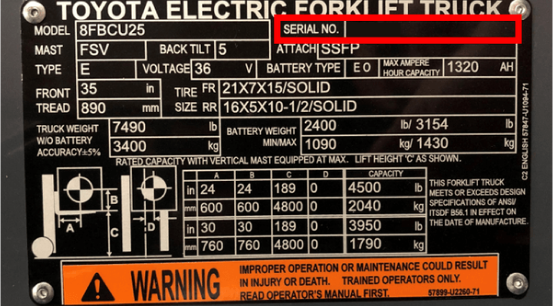
How to Find Your Equipment Model Number.
Finding the right parts for your equipment is easy when you have your model and serial number which can be found on the data plate. Luckily, a forklift data plate is installed on every truck on the market to help you understand what your forklift can do and provide vital information.
Model Number: The model number of your toyota forklift is extremely important for relaying information to your dealers about repair or technical assistance and for looking up replacements part!
Serial Number: The serial number on your lift is the most important number.The model serial number combination will allow us to provide you with the parts that will fit your particular piece of equipment.
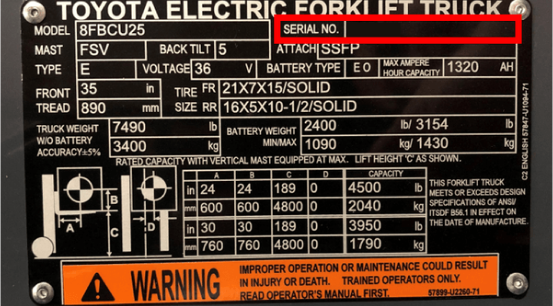
How to Find Your Equipment Serial Number.
Finding the right parts for your equipment is easy when you have your model and serial number which can be found on the data plate. Luckily, a forklift data plate is installed on every truck on the market to help you understand what your forklift can do and provide vital information.
Model Number: The model number of your toyota forklift is extremely important for relaying information to your dealers about repair or technical assistance and for looking up replacements part!
Serial Number: The serial number on your lift is the most important number.The model serial number combination will allow us to provide you with the parts that will fit your particular piece of equipment.
Need some help? For further assistance or more information, contact your local Toyota Dealer.











Please click below to sign in to your MyToyota account
Don't have an account?
Counter-Balanced Forklifts and The Forklift Load Center: A Consideration of Gravity

A forklift load center is the horizontal distance from the vertical face of the forks to the center of gravity of the load. Understanding the load center is critical for forklift safety, as lifting a load beyond the specified load center on your data plate can exceed the forklift’s capacity and cause a potential tip-over.
Forklifts are built for heavy-duty applications, but they still operate within standard physical limits. A counterbalanced forklift relies on a counterbalance weight to offset the weight of the load on the forks. Adhering to forklift limitations stated on the data plate ensures proper forklift operation.
What Is a Forklift Load Center?
According to OSHA, “The load center is the distance from the face of the forks to the load’s center of gravity.”
It is essential for operators and managers to understand the center of gravity of the forklift load in order to transport materials safely. When a load is evenly distributed across a standard 48-inch by 48-inch pallet, the middle of that load (and therefore the load center) is exactly 24 inches. While 24 inches is the industry standard for rating capacity, 30-inch and 48-inch forklift load centers are also common for larger materials.

Understanding the Forklift Fulcrum
If you visualize a forklift as a seesaw, the front axle is the forklift's fulcrum.
The fulcrum is the central pivot point where the forklift and load find their balance. The fulcrum is the dividing line between the weight of the load and the weight of the forklift. The only major difference between a forklift and a playground seesaw is that the forklift counterweight must always provide more downward force than the load; otherwise, the forklift will tip forward.
Why the Data Plate Matters
Manufacturers provide a data plate for every new forklift. This plate contains critical information, including the maximum load capacity at a specified load center.
Ignoring load center guidelines or installing an attachment without notifying the manufacturer can alter the machine's center of gravity, risking damage, accidents, and injuries. If you modify your machine, be sure to notify the manufacturer and request a new data plate to adjust the metrics.
Best Practices for Managing the Center of Gravity
Complex physics equations are involved in calculating the exact de-rating of capacity when a load shifts. Always consult your operator's manual and your local authorized Toyota Forklift Dealer for official safety and operational guidelines. General best practices for managing load centers often include:
- Distribute Weight Evenly: Lifting loads unevenly on the forks (a shifted center of gravity) increases the risk of lateral tip-over. Always ensure the weight is centered horizontally before lifting.
- Slide the Load Back: Be sure to slide the load all the way back until it rests against the load backrest of the forklift. The further the load is placed away from the backrest, the further out you push the load center, which reduces your lifting capacity.
- Re-Plate for Attachments: If you install a new attachment, contact your local OEM dealership to streamline the process of getting a newly calculated data plate.
Toyota Forklifts offers a wide range of sit-down counterbalance forklifts for every operation. For more information, contact your local, authorized Toyota Dealer.