




How to Find Your Equipment Model Number.
Finding the right parts for your equipment is easy when you have your model and serial number which can be found on the data plate. Luckily, a forklift data plate is installed on every truck on the market to help you understand what your forklift can do and provide vital information.
Model Number: The model number of your toyota forklift is extremely important for relaying information to your dealers about repair or technical assistance and for looking up replacements part!
Serial Number: The serial number on your lift is the most important number.The model serial number combination will allow us to provide you with the parts that will fit your particular piece of equipment.
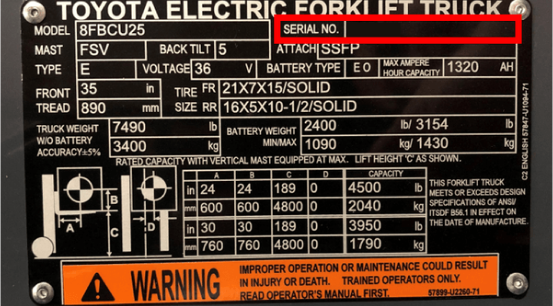
How to Find Your Equipment Serial Number.
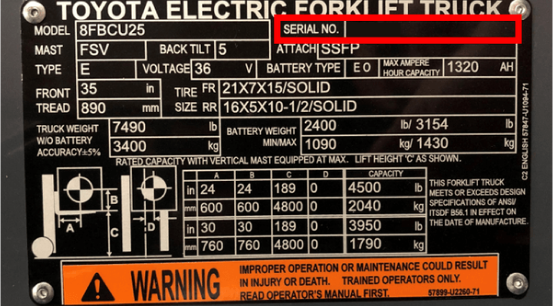
Finding the right parts for your equipment is easy when you have your model and serial number which can be found on the data plate. Luckily, a forklift data plate is installed on every truck on the market to help you understand what your forklift can do and provide vital information.
Model Number: The model number of your toyota forklift is extremely important for relaying information to your dealers about repair or technical assistance and for looking up replacements part!
Serial Number: The serial number on your lift is the most important number.The model serial number combination will allow us to provide you with the parts that will fit your particular piece of equipment.
Need some help? For further assistance or more information, contact your local Toyota Dealer.









Please click below to sign in to your MyToyota account
Don't have an account?
Anatomy of a Hand Pallet Jack

Hand pallet jacks have been a simple, reliable solution for the transportation of pallets throughout the entire supply chain. Understanding how they operate can help you be more productive, safe, and efficient when using one.
This guide will cover hand pallet jack anatomy to help give you a better understanding of the various components and how they work.
These tips do not take the place of reading the user instructions or proper operator training, but they reinforce some of the basic principles for operating a hand pallet jack. Please reference your Operator’s Manual for more information on required training and knowledge needed prior to operation.
Hand Pallet Jack Anatomy
Each part of the pallet jack is essential to its efficient operation.
Starting from the top of the pallet jack, there is the handle and control lever. These are used for manual moving, lifting, and lowering of the pallet jack.
The handle can be rotated left and right to adjust the direction of the steer wheels, changing the direction of travel. It can also be rotated downward, allowing you to pull the pallet jack comfortably.
The control lever is located on the inside of the handle on the right-hand side. It has two different positions, which are used to lift and lower the forks.
- Control Lever Operation (Raised Position) – Squeezing in the control lever causes the lift cylinder to lower, which also lowers the forks. The lowering is proportional, so the more you squeeze, the faster the forks will lower.
- Control Lever Operation (Lowered Position) – Pushing forward on the control lever puts it in the lowered position. When in this position, pulling down on the handle raises the forks proportionally with each motion.
The steer wheels and hydraulic pump are at the base of the unit and are operated using the handle and control lever. There are two different types of wheels available for manual hand pallet jacks: nylon and polyurethane. Read more about these two types of wheels here.
Next, the steel frames comprised of two forks that are connected together at the base. Most hand pallet jacks are designed to handle a standard 40” x 48” pallet. This is due to the dimensions of the forks and the load wheel placement.
The load wheels are located at the end of each fork and are necessary for travel and supporting the load. Just like the steer wheels, there are different types of load wheel compounds available. The load wheels are connected to lift linkages that run the length of the forks. When the handle is used to raise the forks, the lift cylinder extends, causing the linkages to articulate and the load wheels to raise. It’s always important to note the load wheel’s placement before lifting a pallet or other type of load.
