









How to Find Your Equipment Model Number.
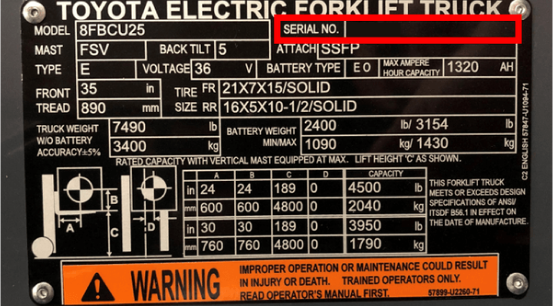
Finding the right parts for your equipment is easy when you have your model and serial number which can be found on the data plate. Luckily, a forklift data plate is installed on every truck on the market to help you understand what your forklift can do and provide vital information.
Model Number: The model number of your toyota forklift is extremely important for relaying information to your dealers about repair or technical assistance and for looking up replacements part!
Serial Number: The serial number on your lift is the most important number.The model serial number combination will allow us to provide you with the parts that will fit your particular piece of equipment.
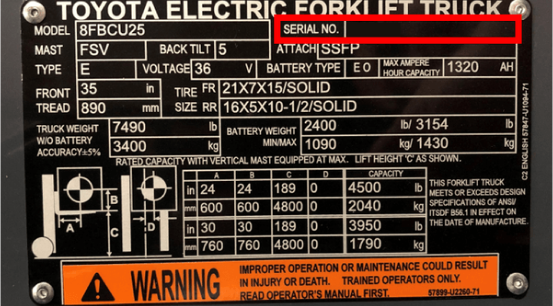
How to Find Your Equipment Serial Number.
Finding the right parts for your equipment is easy when you have your model and serial number which can be found on the data plate. Luckily, a forklift data plate is installed on every truck on the market to help you understand what your forklift can do and provide vital information.
Model Number: The model number of your toyota forklift is extremely important for relaying information to your dealers about repair or technical assistance and for looking up replacements part!
Serial Number: The serial number on your lift is the most important number.The model serial number combination will allow us to provide you with the parts that will fit your particular piece of equipment.
Need some help? For further assistance or more information, contact your local Toyota Dealer.









Please click below to sign in to your MyToyota account
Don't have an account?
Intern-to-Associate Journey with Taylor Young
Quick Summary: As part of our Intern-to-Associate series, Toyota Material Handling interns sit down with former interns who have built their careers at TMH. Through conversations about career growth and mentorship, TMH Associates reflect on where they started, what keeps them at Toyota, and the experiences that have shaped their careers. Whether you’re just starting out or have decades of industry experience, hear their perspectives on learning, growth, and building a meaningful career.
Please introduce yourself. What is your current role at Toyota? How long have you been with the company?
Karanvir: Hi, I’m Karanvir Saini. I’m with the Digital Customer Experience team as an intern, and I’ve been with the company now for 10 weeks.
Taylor: I’m Taylor. I’ve been with the company for five years now. I work in Production Control, and I’m the Assistant Manager for Change Point Control.
Karanvir: Tell us about your Toyota internship experience. What year did you intern, and what was your role?
Taylor: Yeah, so I interned the summer after COVID started, so the summer of 2020. I was an intern in Inventory Control, so within Production Control. I was interning in the group that deals with suppliers, POs, and orders daily. So, I interned there the summer after my sophomore year, and then I actually was a second-time intern after my junior year. Interned in the same group, doing the same role.
Karanvir: Looking back on your internship, what were some of the most valuable lessons or experiences you gained?
Taylor: During my internship, my second one specifically, I got to do a little bit of the day-to-day role. As well as working on a project that all the interns do, and presenting at the end of the internship. But getting a real-life understanding. So, my major was Supply Chain. Supply Chain is a pretty broad topic, and honestly, when I picked Supply Chain as my major, I really didn’t know what it was. It was something where I was working on a project with a professor, I was currently an Accounting, or Accounting major, and through my work, they basically saw that I would be a good candidate for the Supply Chain Program.
So, I joined that my sophomore year and, going into the internship, I really had no idea what I was getting into. So, honestly, the most valuable lesson was just getting the real-world experience of what I was studying. Because a lot of the time, what you are doing in the classroom isn’t exactly one-to-one for what you're going to get in the real world. So, being able to get into the supply chain in a real-world experience. Working with vendors, working with cross-functionally with operations teams in general. And getting to see the shop floor, what I was actually working on firsthand. So that experience helped me, even going back to college after my internship. Being able to have real-life examples or situations or issues that I worked on during my internship, being able to apply those to the rest of my coursework whenever I went back.
Karanvir: What inspired you to return to Toyota after your internship experience?
Taylor: During the summer of 2020, so COVID. And, honestly, a lot of the internships, not a lot, but there were a couple of internships that were canceled during that time because whatever the internship was couldn’t be done remotely. But, fortunately, my internship was able to be done remotely. So, I was actually, I’m from southern Illinois. So, I was back home doing my internship remotely. Which is kind of an odd experience, right? I’m working with a team of people I’ve never met before. But really, what brought me back was during that internship, even being in a completely different state, the people that I was working with and the team that I was on, I really felt like I was at home with them. They made me feel welcome, they made me feel like I was part of the team. They trusted me; they gave me a project and let me work on it independently, but also gave me the support I needed in order to complete it. And so that home-like atmosphere, one of the core values of Toyota, was really shown through that internship when I was not even on-site. So, I think, for me, even coming back for my second internship, that is what brought me back. Is knowing the team that works here, and the support I would get, is really what brought me back for my second internship and ultimately full-time.
Karanvir: For your second internship, were you in person then?
Taylor: Yeah, I was able to come back in person for my second internship.
Karanvir: How did your internship help prepare you for a career and your current role within Toyota?
Taylor: Yeah, so like I said, the internship that I was able to do my second time included both the day-to-day activities of that role as well as a project. And so, focusing more on the day-to-day activities, I was able to understand exactly what I would be doing in that role. And it just so happens after that internship, well right before I started my second internship I had a one-on-one meeting with who would be my manager. And she was kind of explaining, you know, what project I would be working on, and the fact that I would be working on some of the day-to-day activities. And when she was talking about that, she was saying the reason I would be doing some of the day-to-day is because there was an opening in the group, someone had just retired. And, so, I actually took that opportunity, I was a junior at the time. But luckily, I had some college credit from high school, so I was kind of a year ahead. I had a couple of classes left to finish in order to graduate, and so I ended up, during my second internship, finishing those last three classes while I was working. On Friday, I was an intern, and on Monday, I was full-time. So, I kind of slid my way into the department in order to get that full-time role.
But my internships helped me understand exactly what I would be doing, and getting first-hand experience doing that. But again, going back to what brought me to Toyota is those personal connections you make, and especially in the role that I’m in. I think in a lot of roles across Toyota, you’re working cross-functionally on a daily basis. So being able to make those connections in other departments, also as an intern, starting to understand what those roles other departments do. And what their roles are helps you build a little better relationship and that trust. So, whenever I did become a full-time Associate I already had that relationship, or some foundation of that relationship that I was just able to build on.
So, the internship definitely felt like I said helped me gain a foundational understanding of Toyota as a whole. You know, there’s a lot of lingo that gets thrown around, and so as an intern, obviously, you’re trying to soak up as much as you can. But, really, if you do join Toyota full-time, it does help you have a base knowledge of what you’re getting yourself into.
Karanvir: Yeah, I definitely agree. Understanding the ecosystem does take some time. Yeah, it’s frustrating, but once you get it, it is really rewarding.
Taylor: Yeah, I remember as an intern, you know, I work in operations, so you go out to the shop floor, I’ve never been to a manufacturing facility before. I remember a couple of times, like I’m all the way in the back of the shop, and I’m lost, looking for where to go. I think it took like a solid six months to understand where I was at.
Karanvir: What advice would you share with current or prospective Toyota interns who are looking to make the most of their experience?
Taylor: My biggest piece of advice, looking back on my own journey, would be to not be afraid to put yourself in places that you don’t think you belong. So, even looking back on me applying to the internship. So, I met Toyota through a career fair at college. I went to Indiana State, and I remember my professor telling me some of the companies that would be there. And, I remember him telling me that he thought I would be a great fit for Toyota. And I remember hearing the name, obviously. At the time, not even really knowing that they built forklifts. But just the name itself, and I was like, “I’m a sophomore. I’ve taken no coursework on supply chain at this point.”
And I’m like, there’s no way a company like that with that big of a name, right, that is going to take a chance on a sophomore that has no experience at all. No education on the program at all. And so, I remember going into the career fair and walking up to the table, and I was so nervous to talk to them. But again, I think Toyota really invests in hiring people who have the core values that they want. And I think it’s evident through the people that they send to career fairs and things like that. So, I was able to feel more comfortable after I was talking to them, they made me feel welcomed. And I remember sitting in the interview for the internship, and I remember them asking me what my biggest weakness was. And I’ll never forget that I said, “My knowledge.”
Like, I was just very honest with them where I was at. But I think they saw my ambition and my willingness and my eagerness to learn, and that’s kinda what got me here. So don’t be afraid if you have the ambition, the drive, you want to learn, and you can make and can show that through your interview. Don’t be afraid to do things that you don’t feel like you are qualified for. And even joining Toyota full-time you know I’ve been asked to work on projects or have been given tasks that I feel like I have no idea where to start or why would they give that to me. But those are the opportunities, and those are the experiences I feel like have made me grow in my role. And as a young professional, too. So, don’t be afraid to put yourself in positions you don’t think you’re qualified for.
And my second one would be, always be curious. Always ask why, don’t be afraid to ask why. I feel like whenever I’ve, you know, have been in training, and when I first joined and being trained on the processes or whatever tasks I’m going to be doing. I asked “why?” a lot. To the point where I felt like I was being a nuisance, but to be honest with you, that’s how you understand, that’s how you learn. If you don’t understand it, you're not going to be able to do it or teach someone else. Right, so really digging in and asking why, and not accusatory, right, but sometimes, whenever you're asking those questions, the person who is training you might not know. Or the person you're asking may not know. And that may lead to a bigger development or bigger opportunity for improvement of whatever process you’re learning.
So, always be curious and don’t be afraid to put yourself in situations you don’t think you’re qualified for.
Karanvir: Yeah, definitely. Those are good pieces of advice. So, thank you for agreeing to this interview.
Taylor: Of course.
Karanvir: I got a lot of it, so thanks for that.
Looking for a workplace where people support one another, keep improving, and make a difference together? Explore internships and career opportunities at TMHNA to see where you could fit in.