












How to Find Your Equipment Model Number.
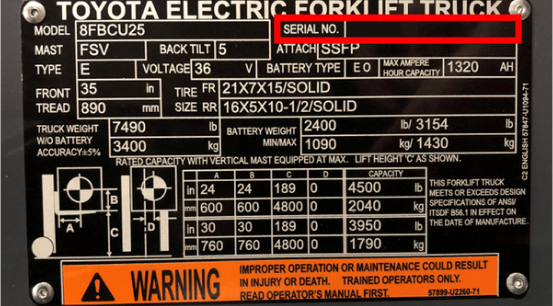
Finding the right parts for your equipment is easy when you have your model and serial number which can be found on the data plate. Luckily, a forklift data plate is installed on every truck on the market to help you understand what your forklift can do and provide vital information.
Model Number: The model number of your toyota forklift is extremely important for relaying information to your dealers about repair or technical assistance and for looking up replacements part!
Serial Number: The serial number on your lift is the most important number.The model serial number combination will allow us to provide you with the parts that will fit your particular piece of equipment.
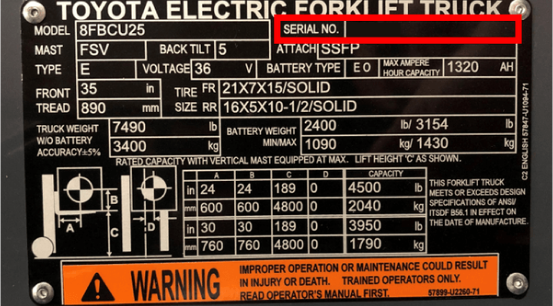
How to Find Your Equipment Serial Number.
Finding the right parts for your equipment is easy when you have your model and serial number which can be found on the data plate. Luckily, a forklift data plate is installed on every truck on the market to help you understand what your forklift can do and provide vital information.
Model Number: The model number of your toyota forklift is extremely important for relaying information to your dealers about repair or technical assistance and for looking up replacements part!
Serial Number: The serial number on your lift is the most important number.The model serial number combination will allow us to provide you with the parts that will fit your particular piece of equipment.
Need some help? For further assistance or more information, contact your local Toyota Dealer.









Please click below to sign in to your MyToyota account
Don't have an account?
Importance of Overhead Guards and Additional Safety Precautions

Every day, forklift operators have a commitment to safety and protection for themselves and those around them. Toyota forklifts have overhead guards designed to help protect operators from falling objects and other obstructions in your facility.
Overhead Guards Help Protect Operators
Since their development in the 1960’s, forklift overhead guards have helped to protect operators from falling packages, boxes, and bagged materials. The overhead guard itself is a cage-like sturdy structure covering the overhead of the operator. It is designed with small openings as to not obscure the operators view when looking up to place and retrieve loads. Per OSHA requirements and ANSI standards, they are required for the protection and safety of the forklift operator.
While overhead guards are a vital safety asset to any forklift machine, they are not meant to protect against every possible impact. For example, in the event of a falling capacity load, the support of the overhead guard structure that received the heaviest loading is designed to absorb energy and deform to deflect the falling capacity load. This is a hazardous situation for an operator, as falling loads are unpredictable. Therefore, the specific training and safety procedures and protocol in your facility should be adhered to and overhead guards are not a substitute for good judgment and care in load handling. A daily inspection of the overhead guards to check for anything broken, damaged, or missing could help to prevent serious accidents. Some additional helpful safety measures in overhead guard usage include:
Wear A Hard Hat For Additional Overhead Protection When Applicable
Certain industries require hard hat usage when operating forklifts. You should analyze your facilities and application to see whether this is a necessary precaution.
Always Keep Hands, Feet And Other Body Parts Inside The Forklift
Falling objects could come from any direction. It’s vital to keep your whole body within the bounds of the forklift and under the overhead guard. The overhead guard is intended for protection while an operator is within the confines of the seat. Also, operators are prohibited from operating forklifts with their hands, arms, feet, legs or any other body parts around the overhead guard supports or while outside the overhead guard.
Never Try To Fix An Overhead Guard Without Professional Help
Always reach your local dealer with assistance repairing or replacing an overhead guard. It is against OSHA requirements to use a forklift with a damaged overhead guard.
Get Any Additions Approved By Your Manufacturer
Any modification to the forklift including its overhead guard that alters the specs of the forklift can cause potential hazards. You are required to get manufacturer approval before making alterations to the forklift including its overhead guard that affect safe forklift operation.
With any questions about overhead guards, contact your local Toyota Forklift dealer.