










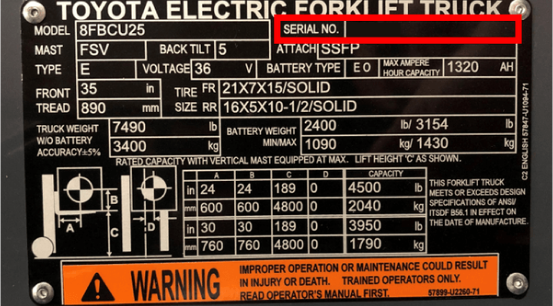
How to Find Your Equipment Model Number.
Finding the right parts for your equipment is easy when you have your model and serial number which can be found on the data plate. Luckily, a forklift data plate is installed on every truck on the market to help you understand what your forklift can do and provide vital information.
Model Number: The model number of your toyota forklift is extremely important for relaying information to your dealers about repair or technical assistance and for looking up replacements part!
Serial Number: The serial number on your lift is the most important number.The model serial number combination will allow us to provide you with the parts that will fit your particular piece of equipment.
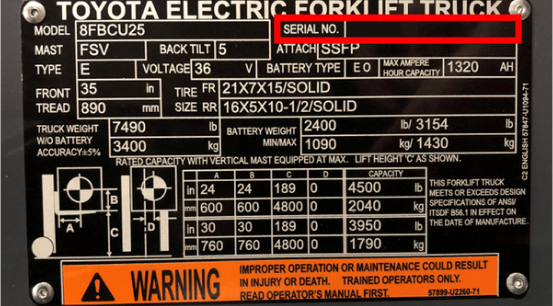
How to Find Your Equipment Serial Number.
Finding the right parts for your equipment is easy when you have your model and serial number which can be found on the data plate. Luckily, a forklift data plate is installed on every truck on the market to help you understand what your forklift can do and provide vital information.
Model Number: The model number of your toyota forklift is extremely important for relaying information to your dealers about repair or technical assistance and for looking up replacements part!
Serial Number: The serial number on your lift is the most important number.The model serial number combination will allow us to provide you with the parts that will fit your particular piece of equipment.
Need some help? For further assistance or more information, contact your local Toyota Dealer.









Please click below to sign in to your MyToyota account
Don't have an account?
Forklift Fuel Options And Buying Considerations

When choosing the right forklift for your operation, one of the biggest decisions is whether to go electric or internal combustion (IC). Both electric and IC forklifts offer distinct advantages, but understanding their differences is essential to selecting the right equipment for your application. From operating costs and maintenance requirements to performance and versatility, several factors should be considered when determining which forklift best meets your needs.
Electric Forklifts
Electric forklifts continue to gain popularity as technological advancements expand their capabilities. With electric forklifts now accounting for more than 70% of the forklift market, innovations in battery technology, fast-charging capabilities, and performance enhancements are helping deliver the power, runtime, and efficiency needed for demanding operations. These advancements are making electric forklifts an increasingly viable alternative to traditional internal combustion (IC) forklifts across a wide range of applications.
Electric Forklift Advantages
- No exhaust emissions while operating: Electric forklifts are powered by electrical energy sources such as batteries or fuel cells, which eliminates an employee’s exposure to exhaust emissions while operating the forklift.
- Reduced maintenance costs: Electric forklifts do not produce engine fluid, and a high percentage of batteries are recyclable.
- Operator ergonomics: Less noise and vibration are generated by the electric forklift, which reduces operator fatigue.
- Decreased repair costs: Electric forklifts have fewer parts to maintain and repair. Additionally, AC motor technology further eliminates brushes to reduce spark hazards and improve speed control.
- Lower long-term fuel costs: Batteries for the electric forklift are rechargeable. Although the upfront costs for batteries and chargers can be high, the return on investment over time is typically higher than when using fuel.
With these advantages come other factors to consider. Although electric forklifts have lower lifetime fuel costs, their initial costs are higher. In addition to the cost of the battery, some operations require an area for charging, watering, and cleaning. Many forklifts are designed to protect critical components from water intrusion that could cause damage.
IC Forklifts
The market for IC forklifts remains strong. They account for about 30% of the forklift market and are viable solutions for both indoor and outdoor applications. IC forklifts tend to be more popular for constant operations with little to no downtime.
IC Forklift Advantages
- Flexible application: IC forklifts work well indoors and outdoors. They operate well in rain and other inclement weather.
- Lower initial cost: On propane-powered forklifts, only the investment in propane tanks and their storage area is needed to operate the forklift. Gasoline and diesel-powered forklifts are usually purchased when refilling stations are conveniently available. The infrastructure for these stations, however, can be very expensive if they don’t already exist at your facility.
- Easy to refuel: When propane forklifts run out of fuel, an operator can easily replace the propane tank in a few minutes and resume production. Gasoline and diesel-powered forklifts can also be refueled in a matter of minutes (depending on their location). Quick fueling is an advantage in multi-shift operations.
Other factors to consider include:
- Providing warehouse ventilation
- Operator fatigue from noise and vibration
- Physical requirement of changing propane tanks
If your operation does not require an IC forklift, then the benefits of reduced maintenance, repairs, and fuel costs might outweigh the increased upfront cost.
LP vs. Dual Fuel vs. Diesel Powered Forklifts
Liquid Propane (LP)
If you are located in an area that does not have gasoline or diesel refilling stations readily available, LP is an ideal choice. If you are purchasing forklifts for a new facility, LP has the lowest initial cost. All you need to purchase are LP tanks and a place to store them. LP tanks have to be stored outdoors in a locked storage container and labeled with proper hazard signs. LP tanks can also be changed in a matter of minutes, reducing your downtime when refueling. LP forklifts are available with both cushion and pneumatic tires and are ideal for both indoor and outdoor operations.
Dual Fuel
Dual fuel offers the flexibility of operating on both gasoline and LP, allowing operators to switch between fuel types based on availability and application needs. The versatility can help minimize downtime by ensuring a backup fuel option is always accessible. While they may require the infrastructure to support both fuel types, they can provide operational convenience for mixed-use fleets. The added complexity of maintaining two fuel systems may increase service considerations compared to single-fuel options.
Diesel Forklifts
Diesel fuel is highly efficient and can provide longer run times compared to other fuel types. A by-product of diesel combustion is soot, which can accumulate in a forklift's exhaust system and needs to be removed. In general, diesel engines also have higher torque than their LP or gas counterparts, which can provide increased gradeability and acceleration. Though diesel traditionally costs more per gallon than gasoline, it can provide a better return on investment over the years of use. Diesel-powered forklifts are only available with pneumatic tires and are designed for outdoor use.
Frequently Asked Questions
What specific industries or applications are best suited for electric forklifts compared to IC forklifts?
IC forklifts perform well in outdoor environments but can have difficulty maneuvering in tight spaces. However, electric forklifts excel in small, indoor spaces.
How do the maintenance requirements and schedules differ between electric and IC forklifts?
Service requirements vary between electric and IC forklifts, depending on the components that power each. With fewer moving parts, Toyota’s Electric Forklifts usually require less routine maintenance. Toyota’s IC Forklifts require more frequent maintenance due to their powerful engines. Following the recommended maintenance schedule for either power source can support reliable, long-lasting performance.
Request a consultation from your authorized Toyota dealer to help you determine which forklift(s) would work best for your operation. Our forklift experts will work directly with your business to determine the best option(s) to tackle whatever challenges you might be facing.