



















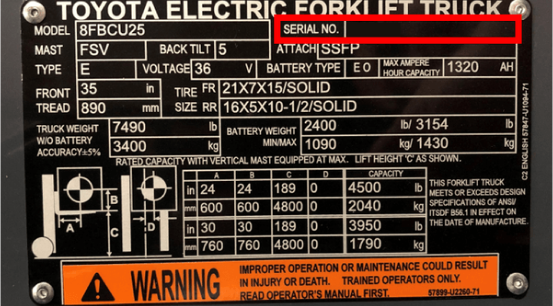
How to Find Your Equipment Model Number.
Finding the right parts for your equipment is easy when you have your model and serial number which can be found on the data plate. Luckily, a forklift data plate is installed on every truck on the market to help you understand what your forklift can do and provide vital information.
Model Number: The model number of your toyota forklift is extremely important for relaying information to your dealers about repair or technical assistance and for looking up replacements part!
Serial Number: The serial number on your lift is the most important number.The model serial number combination will allow us to provide you with the parts that will fit your particular piece of equipment.
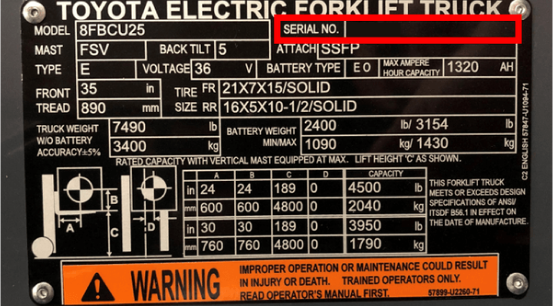
How to Find Your Equipment Serial Number.
Finding the right parts for your equipment is easy when you have your model and serial number which can be found on the data plate. Luckily, a forklift data plate is installed on every truck on the market to help you understand what your forklift can do and provide vital information.
Model Number: The model number of your toyota forklift is extremely important for relaying information to your dealers about repair or technical assistance and for looking up replacements part!
Serial Number: The serial number on your lift is the most important number.The model serial number combination will allow us to provide you with the parts that will fit your particular piece of equipment.
Need some help? For further assistance or more information, contact your local Toyota Dealer.













Please click below to sign in to your MyToyota account
Don't have an account?
What Forklift Tires & Options Do I Need?

Toyota offers a variety of forklift tire types: Cushion Tires, Solid Pneumatic Tires, and Air Filled Pneumatic Tires. Understanding the differences between them can help you determine which option is best suited for your application, operating environment, and performance needs.
Tire Options
Forklift tires are available in three types: Cushion, Solid Pneumatic, and Air Pneumatic.
Tire Type | Description |
Cushion Tires | Cushion Tires are composed of solid rubber and are pressed direcly onto the wheel. They are primarily suited for forklifts operating in indoor, smooth-floor applications which commonly require a tight turning radius. |
Pneumatic Tires (Solid) | Pneumatic Tires (Solid) are made of solid rubber, much like a cushion tire, and are a popular tire on the market today. Solid pneumatic tires are commonly used for both indoor and outdoor applications. However, solid pneumatic tires do not offer the same comfortable ride as a cushion tire does across paved surfaces. They have a deep tread and are made of strong, long-lasting rubber material. The initial investment is higher, but they are more durable, possibly puncture-resistant, and have a very long life. |
Pneumatic Tires (Air Filled) | Pneumatic Tires (Air-Filled) are made of rubber, but are air-filled, much like a car or truck tire. They have a deep tread and are made of strong, long-lasting rubber material. These tires are better for rough, outdoor terrain. |
How to Choose the Right Forklift Tire
Selecting the right Toyota forklift tire starts with understanding your operating environment, application demands, and performance priorities.
Consider Your Operating Environment
- Indoor operations: Cushion tires are primarily suited for forklifts operating in indoor, smooth floor applications, which commonly require a tight turning radius.
- Outdoor operations: Air pneumatic tires are ideal for rough terrain, uneven surfaces, gravel, or wet conditions where traction and shock absorption are important.
- Mixed-use applications: Solid tires offer a balance between durability and versatility for operations that move between indoor and outdoor environments.
Evaluate Surface Conditions
The condition of your facility floors or yard surfaces can significantly impact tire performance and longevity. Smooth concrete floors generally work well with cushion tires. Rough pavement, debris, and uneven terrain may require pneumatic options for added stability and durability.
Think About Load Requirements
Heavy loads and high-duty-cycle applications may require tires designed for increased durability and heat resistance. Choosing the correct forklift tire type can help improve load stability and reduce wear over time.
Prioritize Operator Comfort and Ergonomics
Forklift tires can directly impact operator comfort and overall productivity. Tires that absorb shock and vibration more effectively can help reduce operator fatigue during long shifts, especially in outdoor or uneven surface applications. Pneumatic tires typically provide better cushioning and ride comfort, while cushion tires support maneuverability and responsiveness in indoor environments. Pairing the right tire configuration with ergonomic features like an adjustable seat can help create a smoother ride, improve operator positioning and support, and enhance overall comfort throughout the workday.
Consult Your Forklift Dealer
Your forklift dealer can help evaluate your application, facility conditions, and operational goals to recommend the best tire configuration for your fleet. Request a Quote or for pricing, parts & more, click here to find a dealer near you.
Frequently Asked Questions About Forklift Tire Types
What type of forklift tire do I need?
The right forklift tire depends on your operating environment, surface conditions, and application requirements. Cushion tires are commonly used for indoor applications on smooth warehouse floors because they offer a smaller turning radius and improved maneuverability. Solid pneumatic tires are often used for mixed indoor and outdoor applications due to their durability, while air pneumatic tires are better suited for rough outdoor terrain where traction and shock absorption are important. Your Toyota forklift dealer can help evaluate your facility conditions and operational goals to recommend the best tire configuration for your fleet. Click here to find a dealer near you.
What are the three types of forklift tires?
Forklift tires are typically available in three main types: cushion, solid pneumatic, and air pneumatic tires. Cushion tires are composed of solid rubber and are pressed directly onto the wheel for indoor maneuverability. Solid pneumatic tires are also made of solid rubber and are designed for durability across indoor and outdoor applications. Air-filled pneumatic tires feature deep tread patterns designed to provide traction and shock absorption on rough outdoor surfaces.
How do forklift tires affect performance and operator comfort?
Forklift tires can directly impact handling efficiency, load stability, traction, operator comfort, and workplace safety. Choosing the correct tire type helps optimize maneuverability and ride quality based on the operating environment. Cushion tires support responsive handling in indoor warehouse applications with tighter turning radii, while pneumatic tires provide improved shock absorption and traction on uneven outdoor surfaces. The right tire configuration, combined with ergonomic features like an adjustable operator seat, can help reduce vibration and operator fatigue throughout the workday.
Which forklift tire is best for indoor applications?
Cushion tires are typically the preferred option for indoor applications because they are designed for smooth warehouse floors and tight operating spaces. They are suited for forklifts operating in indoor, smooth-floor applications that require a tight turning radius in narrow aisles and confined areas. Cushion tires also sit lower to the ground, which supports stability and efficient indoor operation.
Which forklift tire is best for outdoor applications?
Air pneumatic tires are commonly recommended for outdoor applications because they provide better traction, shock absorption, and stability on uneven terrain, gravel, and rough pavement. Solid pneumatic tires can also be a good option for operations that move between indoor and outdoor environments and require additional durability.
What is the difference between cushion and pneumatic forklift tires?
Cushion tires are made of solid rubber and are designed primarily for indoor applications on smooth warehouse floors. They sit lower to the ground and are suited for forklifts operating in indoor, smooth-floor applications, which commonly require a tight turning radius to improve maneuverability in tight spaces and narrow aisles. Pneumatic tires are designed for outdoor or mixed-use applications and provide enhanced traction and shock absorption on uneven terrain. Solid pneumatic tires offer added durability, while air pneumatic tires provide a more cushioned ride on rough surfaces.
How long do forklift tires last?
Forklift tire lifespan depends on several factors, including operating environment, application intensity, load weight, floor conditions, and maintenance practices. Tires used on rough surfaces or in high-use applications may wear more quickly than those operating on smooth indoor floors. Regular tire inspections and proper maintenance can help extend tire life and support consistent forklift performance and safety.